Understanding the fundamental physical principles that govern material behavior and the interactions between materials at the atomic level. Modification of physical properties.
Atomic Composition of Materials
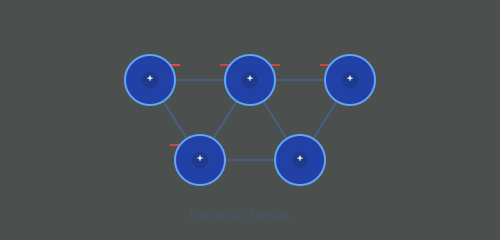
All materials consist of atoms and molecules held together by electrical forces. These electromagnetic interactions between charged particles determine the fundamental mechanical, vibrational, and electronic properties of materials.
Atoms/Molecules
Fundamental building blocks of matter with positively charged atomic nuclei (protons, neutrons) and negatively charged electrons
Electric Forces
Electromagnetic interactions (Coulomb forces) between charged particles
Force Direction
Attractive/repulsive forces determine material cohesion
Derived Material Properties, Work Function
The strength of interatomic electrical forces directly influences three key material properties that are critical for engineering applications. The intrinsic work function is the fundamental electrical material property. Movement of electrons within the material.
Fundamental vibrational frequency of atomic lattice
f₀ = (1/2π)√(k/m)
Stronger bonds → higher spring constant k → higher natural frequency
Unit: Hz
Electron Work Function
Φ
Minimum energy to remove electron from surface
Φ = E_vacuum − E_Fermi
Binding strength determines energy barrier for electron emission
Unit: eV (electron volts)
Contact Potential Difference (CPD)
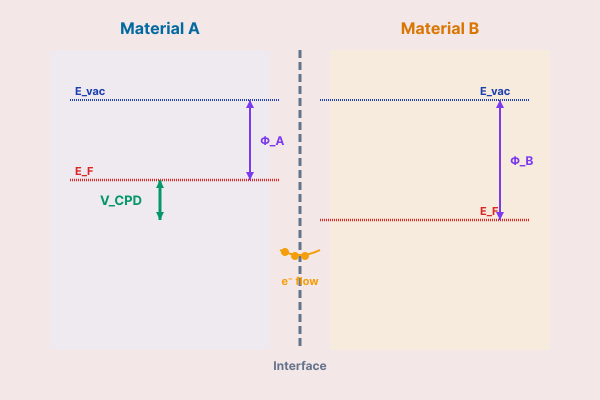
When two different materials come into contact, a contact potential difference (CPD) arises due to their differing work functions. This phenomenon is fundamental to understanding interface behavior in electronic components and sensor applications.
Energy Band Diagram at Material Interface
Vacuum Level (Evac)
Reference energy for free electrons
Fermi Level (EF)
Highest occupied electron energy state
Work Function (Φ)
Energy needed to remove electron from surface
Contact Potential (VCPD)
Voltage difference at equilibrium
Key Relationship
VCPD = (ΦA − ΦB) / e
Electrons flow from lower to higher work function until Fermi levels align, creating an electrostatic potential difference at the interface.
Physical Mechanism
The work function (Φ) represents the minimum energy required to remove an electron from a material's surface. When materials with different work functions come into contact, electrons flow from the material with the lower work function to the material with the higher work function until equilibrium is reached. This creates a contact potential difference: VCPD = (ΦA − ΦB)/e
Functional Principle of the WZ Chips
How the WZ chip system converts mechanical energy through interactions at the physical level.
01
WZ Chip Structure
Chip with capacitors + resonant circuits + adhesive film
02
EM Interaction
Electromagnetic interaction begins at the contact surface
03
Ordering of free electrons, field-effect movement of the electron gas
Optimization of the elastic modulus + shifts in natural frequency
04
Vibration Reduction
Reduction of vibration amplitude achieved within the defined application target range.
Eddy Current Brake Analogy
Similar to how eddy currents create electromagnetic damping without physical contact, WZ chips optimize material properties through controlled electromagnetic interaction, reducing vibrations at the molecular level without adding mass or mechanical components, and without weakening the material's properties.
The electrical circuit elements, through the contact potential difference that arises between the WZ chip and the material, alter the elastic modulus and thereby influence the natural frequency. When these electric fields are accelerated by a mechanical motion of the material excited by external influences, additional magnetic fields are generated. These reduce the vibration amplitude of the moving material, similar to an eddy current brake.
No external power supply required
Simple adhesive application
No material modification required
Before: High Vibration
After: Reduced Vibrations
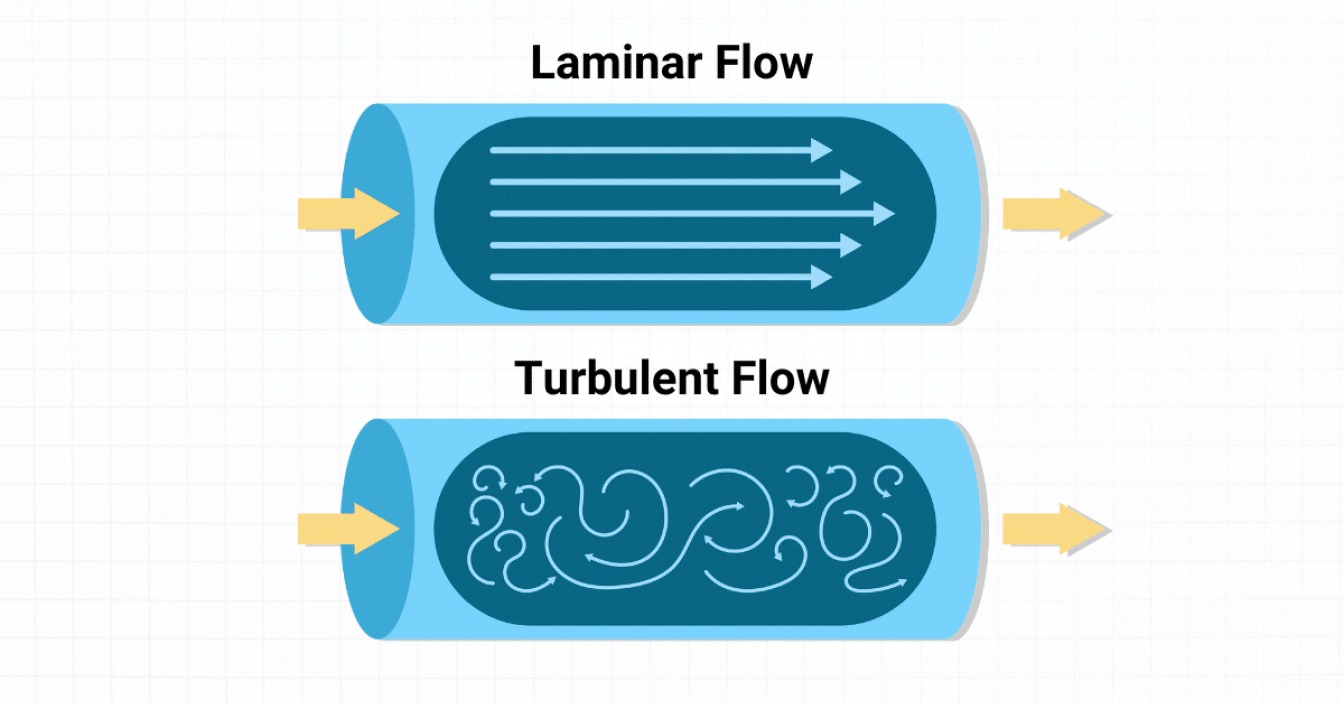
Flow Optimization
In addition to mechanical effects, the technology also influences the flow properties of gases and liquids.
Improved laminar flow, reduced turbulence
Differentiation from Conventional Solutions
Conventional Damping Technologies
Increases overall weight
Requires intervention in the system
Mechanical/passive solution
Structural modification
Complex installation
Pure hardware product
VIBE-EX WZ Chip
No increase in mass
Usable without structural modifications
No mechanical retrofitting required.
Simple application (adhesive bond)
Combined with analysis services
Tailored solutions and personalized applications.
Innovation Timeline
Four decades of research, validation, and real-world application
1980s
Germany
Discovery Phase
Discovery of the influence of programmable materials through electromagnetic interaction
1990s-2000s
Laboratory
Laboratory Validation
Extensive validation on machinery, ships, and railways. Proven effectiveness in industrial environments.
2000s
Elite Sports
Sports Application
Technology adapted for elite sports under the MKC™ / WizardStickers™ brand.
2010s
Liechtenstein
VIBE-EX Acquisition
Acquired by the VIBE-EX consortium, headquartered in Liechtenstein
2010-Present
Global
Continuous Development
Over 10 years of continuous research and development, with steadily growing application areas across various industries